Technological advances support educators as they design and implement courses to serve their ever-growing population. Although many people look to mobile technology to accelerate this process, there is growing evidence that it could be slower due to a lack of support (Martin et al., 2018). Later studies confirm that although technology is important to education, its primary function is to assist the teacher, who is still critical to imparting knowledge (Pathak, 2022).

IXL
Under the section, Grammar and Mechanics and the topic, Sentences, Fragments, and Run-ons, the assignment requires the student to identify the sentence fragment from the choices displayed. Only one sample sentence is shown for each question, and the user is asked to determine whether it is a fragment by clicking Yes or No. When either Yes or No is selected, the submit button comes alive and can be clicked on to submit the response.
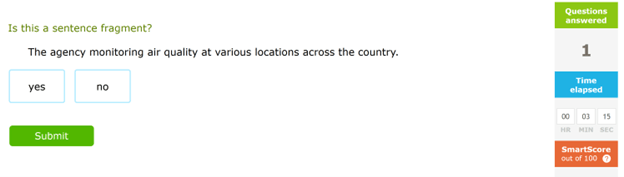
There is a library of more than 100 sample sentences to choose from, and my students vie for a smart score of 100%. A counter also records the answer to each question as a fail or pass. Based on whether the answer is right or wrong, a feedback congratulatory message, or a message of encouragement is displayed. The more responses a student gets wrong, the more the system adjusts the challenge level of the questions. From the questions to the answer, there are only two clicks: one on either Yes or No and the final one on Submit.
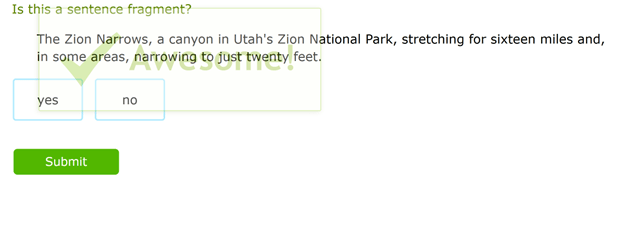
IXL has streamlined a rather complex lesson that would have been planned by researching the lesson content from different sources. The choice of sentences and sentence fragments would have also taken more than three hours to construct. The students would have needed to hand-write the answers, and the teacher would collect the scripts, grade them, and provide feedback to the students in another class session. This IXL lesson takes approximately 30 minutes. IXL’s process is automated, with sentences generated as the student answers. The teacher’s feedback is also immediate, direct, and in real-time.
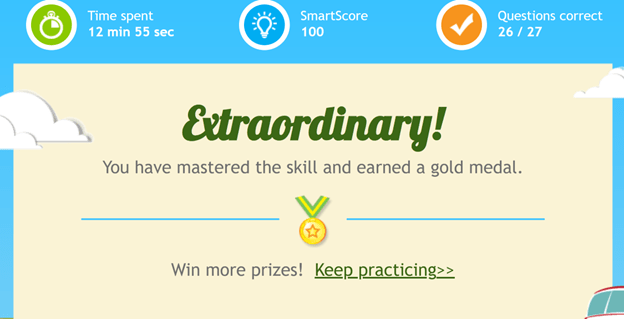
Depending on the student’s performance, the questions are modified, and the student is rerouted to more suitable choices. The teacher can remotely monitor the students if they are in a live class and use Analytics look-up to determine the weak areas for each student. This is done to tailor the instruction to the student’s needs.
NoRedInk
NoRedInk is designed to cater to English Language Arts and Social Studies curricula. Once the teacher logs on to Assignment Library and chooses Skills Building, the teacher will select the lesson on Homophones or sound-alike words. A brief lesson objective is provided with specific homophones, which will be analyzed. A 5-20 minute Tutorial is also provided.
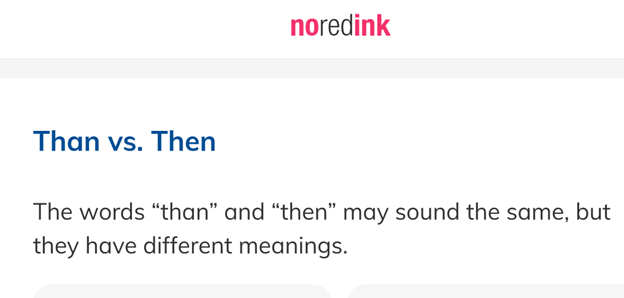
These are inbuilt capabilities that are automatically designed for the students as they access the lesson. A tutorial requires two mouse clicks to guide the lesson in terms of clicking the correct answer. The tutorial drills down into each homophone a student selects and leads them to the underlying differences between the words from meaning to structure.
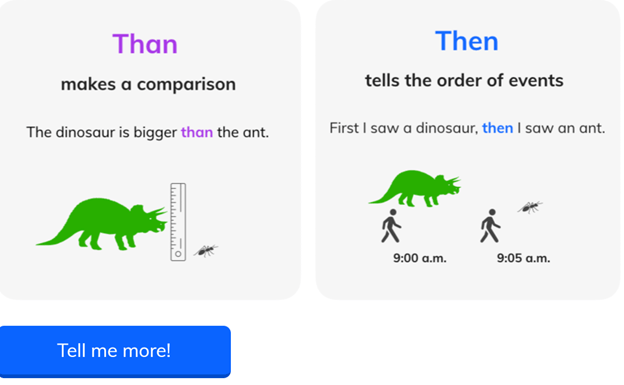
After providing a deep exploration of the homophones, it gives the student a Practice area in which the student explores the composition of the homophones and their distinct structural and semantic differences. The hands-on lesson is well-chunked, focused, and directed towards clarifying all the doubts surrounding the soundalikes.
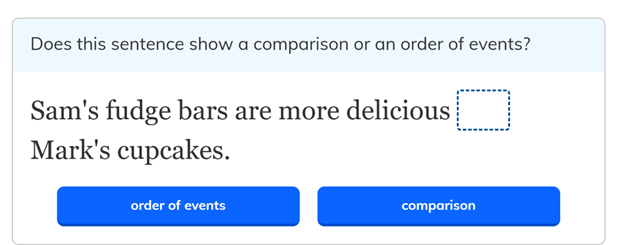
As in IXL, the teacher can grade the exercises using artificial intelligence, which grades automatically as a built-in tool component.

These tools demonstrate what an educator can do with software to help speed the processes that would have otherwise taken so long to accomplish (American College of Education, 2023). They may not be cloud-based, but they are accessible only through an internetwork connection. This means they are accessible globally, and the students can do their work and have it assessed and graded from anywhere and at any time (American College of Education, 2023).
References
American College of Education. (2023). Productivity Applications for Education. https://ace.instructure.com/courses/2017353/external_tools/118428
Martin, G.; Khajuria, A.; Arora, S.; King, D.; Ashrafian, H.; Darzi, A. (2018). The impact of mobile technology on teamwork and communication in hospitals: a systematic review. Journal of the American Medical Informatics Association, 26(4). https://doi.org/doi:10.1093/jamia/ocy175
Pathak, T. (2022). Innovative Technology in Higher Education: Opportunities and Challenges. Journal of Management & Public Policy,13(2), 4–15. https://doi.org/10.47914/jmpp.2022.v13i2.001


Leave a Reply